Image-Space Russian Roulette for Monte Carlo Rendering
Gwangju Institute of Science and Technology
ACM SIGGRAPH ASIA 2026 Conference Proceedings
Abstract
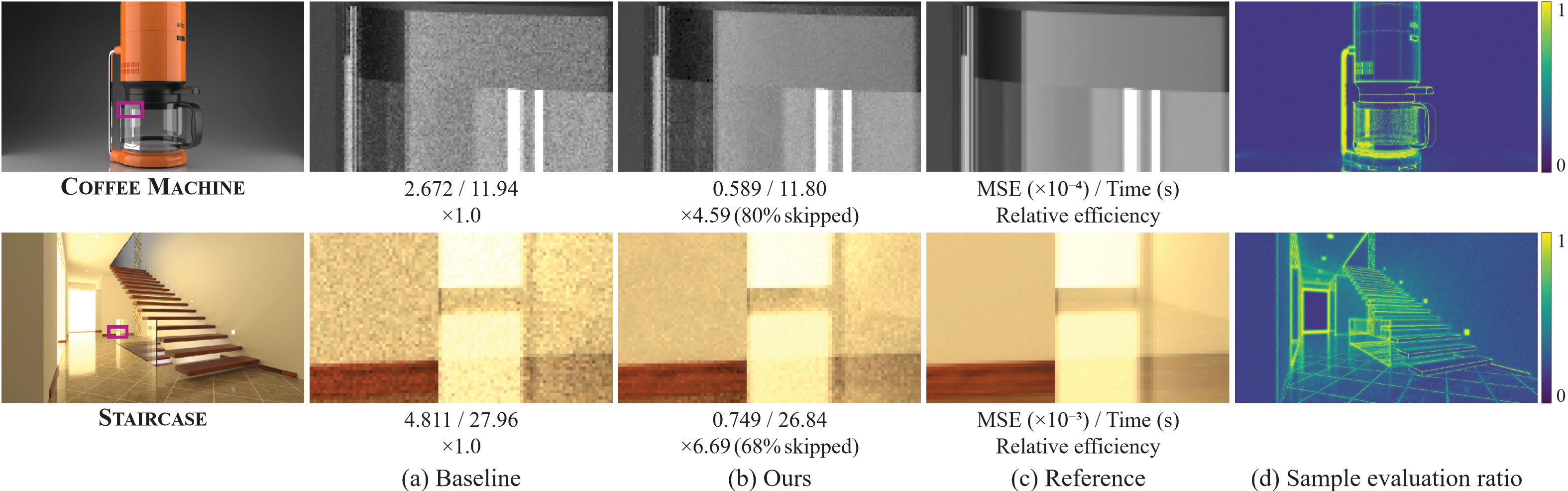
Russian roulette (RR) is a widely used technique for reducing computational cost in Monte Carlo (MC) rendering, which often requires a large number of samples to achieve low-noise results. In standard practice, RR probabilistically terminates suffix paths at path vertices when their expected contribution is low, returning a predefined termination value (e.g., zero) in place of the skipped contribution. In this paper, we introduce an imagespace RR framework that operates directly in image space, enabling early termination of entire light paths before ray traversal. We generalize RR by introducing sample-dependent termination values, allowing skipped contributions to be approximated rather than discarded. To make this formulation practical, we exploit spatial correlation through a seed-shifting strategy that reuses primary samples across neighboring pixels. This enables efficient construction of both termination values and termination probabilities using correlated evaluations. We demonstrate that our method achieves lower error than baseline path tracing under equal-time conditions across a variety of scenes while remaining unbiased and compatible with existing techniques such as vertex-level RR.
Contents
- Main Report - Author's version (TBD)
- Main Report - Publisher